
Understanding How Violence Affects Children

The Children's Domestic Abuse Wheel illustrates the many ways domestic violence harms young lives — from isolation and emotional abuse to physical, mental, and sexual impacts. Understanding these dimensions is the first step toward meaningful support and healing.
Domestic abuse is never a private matter when children are in the home.
Children do not have to be directly struck to be profoundly harmed. Research is clear: witnessing violence is itself a form of abuse. When a home becomes a place of fear, every aspect of a child's development — emotional, social, physical, educational — is placed at risk.
The Children's Domestic Abuse Wheel, developed by CDASS and adapted from the Domestic Abuse Prevention Project in Duluth, MN, gives us a powerful framework for understanding the full scope of this harm. It centers the child's experience and names the specific, overlapping ways violence reverberates through their young lives. By naming what children experience, we create space to address it — and to heal it.
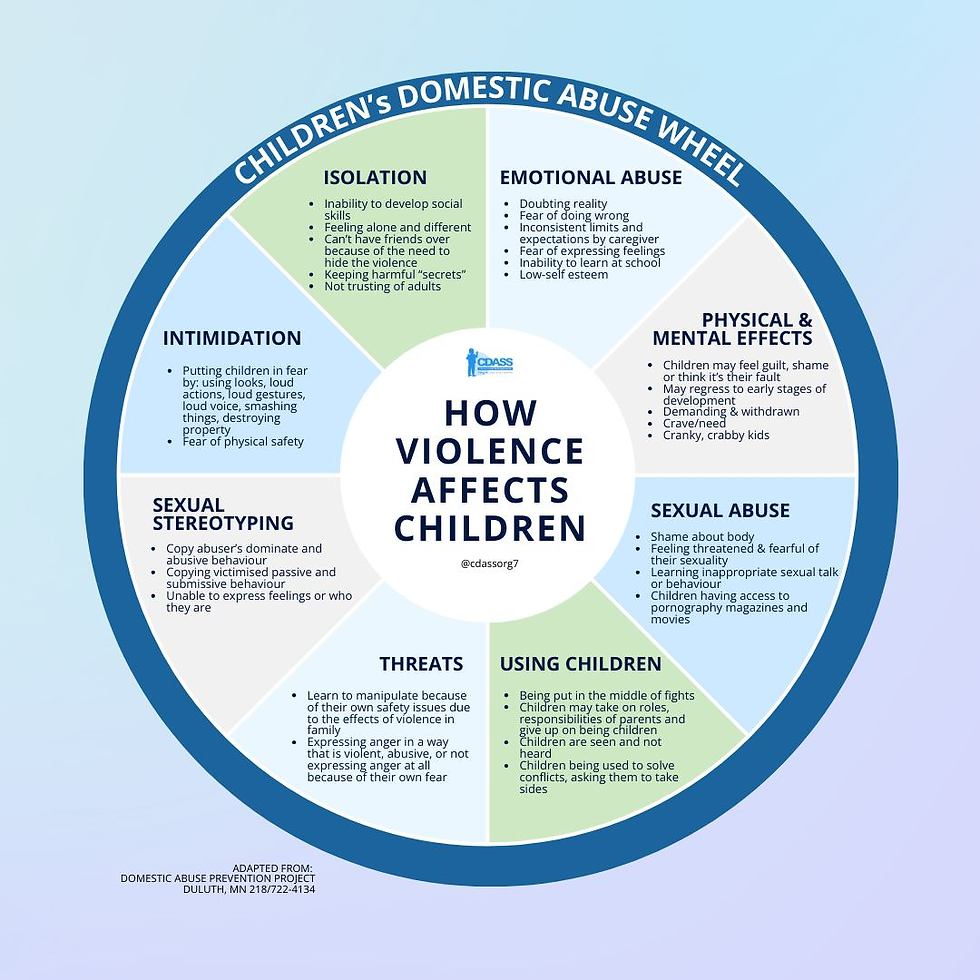
Isolation
Inability to develop social skills
Feeling alone and different
Can't have friends over because of the need to hide the violence
Keeping harmful "secrets"
Not trusting of adults
Emotional Abuse
Doubting reality
Fear of doing wrong
Inconsistent limits and expectations by caregiver
Fear of expressing feelings
Inability to learn at school
Low self-esteem
Physical & Mental Effects
Children may feel guilt, shame or think it's their fault
May regress to early stages of development
Demanding & withdrawn
Crave/need
Cranky, crabby kids
Sexual Abuse
Shame about body
Feeling threatened & fearful of their sexuality
Learning inappropriate sexual talk or behavior
Children having access to pornography magazines and movies
Using Children
Being put in the middle of fights
Children may take on roles and responsibilities of parents and give up on being children
Children are seen and not heard
Children being used to solve conflicts, asking them to take sides
Threats
Learn to manipulate because of their own safety issues due to the effects of violence in family
Expressing anger in a way that is violent, abusive, or not expressing anger at all because of their own fear
Sexual Stereotyping
Copy abuser's dominate and abusive behavior
Copying victimized passive and submissive behavior
Unable to express feelings or who they are
Intimidation
Putting children in fear by: using looks, loud actions, loud gestures, loud voice, smashing things, destroying property
Fear of physical safety
Children who witness domestic abuse are not bystanders — they are victims. The home is their entire world. When that world is unsafe, every part of their development bears the cost.
Why Naming These Harms Matters
For too long, the impact of domestic abuse on children has been minimized — often because the children themselves were not directly hit. The Children's Domestic Abuse Wheel challenges this head-on. It shows that violence operates across multiple dimensions simultaneously, and that each one leaves a mark.
When a child is forced to keep "harmful secrets," they lose their ability to trust adults who might otherwise protect them. When they witness intimidation — loud voices, smashing things, destruction of property — they internalize that as normal. When they are placed in the middle of adult conflicts, they are robbed of their childhood and handed burdens no child should carry.
Naming these experiences accurately — isolation, emotional abuse, sexual stereotyping, threats — creates the conditions for children to be believed, supported, and healed. It also equips teachers, healthcare workers, and community members to recognize the signs and respond with competence and compassion.
1 in 5
children witness domestic abuse during childhood
60%
of domestic abuse cases involve children in the home
3×
more likely to face mental health difficulties as adults
These numbers are not abstractions — they are children in our schools, our neighborhoods, our communities. They are children who, with the right support, can and do heal.
From Harm to Healing — What Children Need
The good news embedded in every dimension of the Wheel is that harm named can be harm addressed. Children who are isolated can be reconnected to safe, trusted relationships. Children who have learned to doubt reality can find their ground again. Children who have taken on adult responsibilities can be given space to simply be children.
Trauma-informed care is at the heart of this work. It means understanding that a child's behavior is communication — that withdrawal, aggression, or regression are not character flaws but survival responses. It means leading with safety, consistency, and warmth before anything else.
It also means working with the non-abusive parent or caregiver, supporting them to be the stable anchor their child desperately needs. Healing rarely happens in isolation — it unfolds within relationships, and those relationships need nurturing too.
National Abuse Hotline: 1-800-799-(SAFE)7233 or Text "START" to 88788
You can also find additional support at Exalted Valley Ministries.


Comments